

MCP
Expose the read-only tools and investigate / triage / explain / generate to external agents (Claude Desktop, Cursor, your own): Streamable HTTP, tokens issued per role, the same gates and audit as the UI. Since 1.9.0.
The MCP server is a resident process that starts and stops with splunkd (bin/copilot_mcp_server.py, a scripted input with interval=-1). Off by default; the switch on Settings → MCP takes effect immediately.
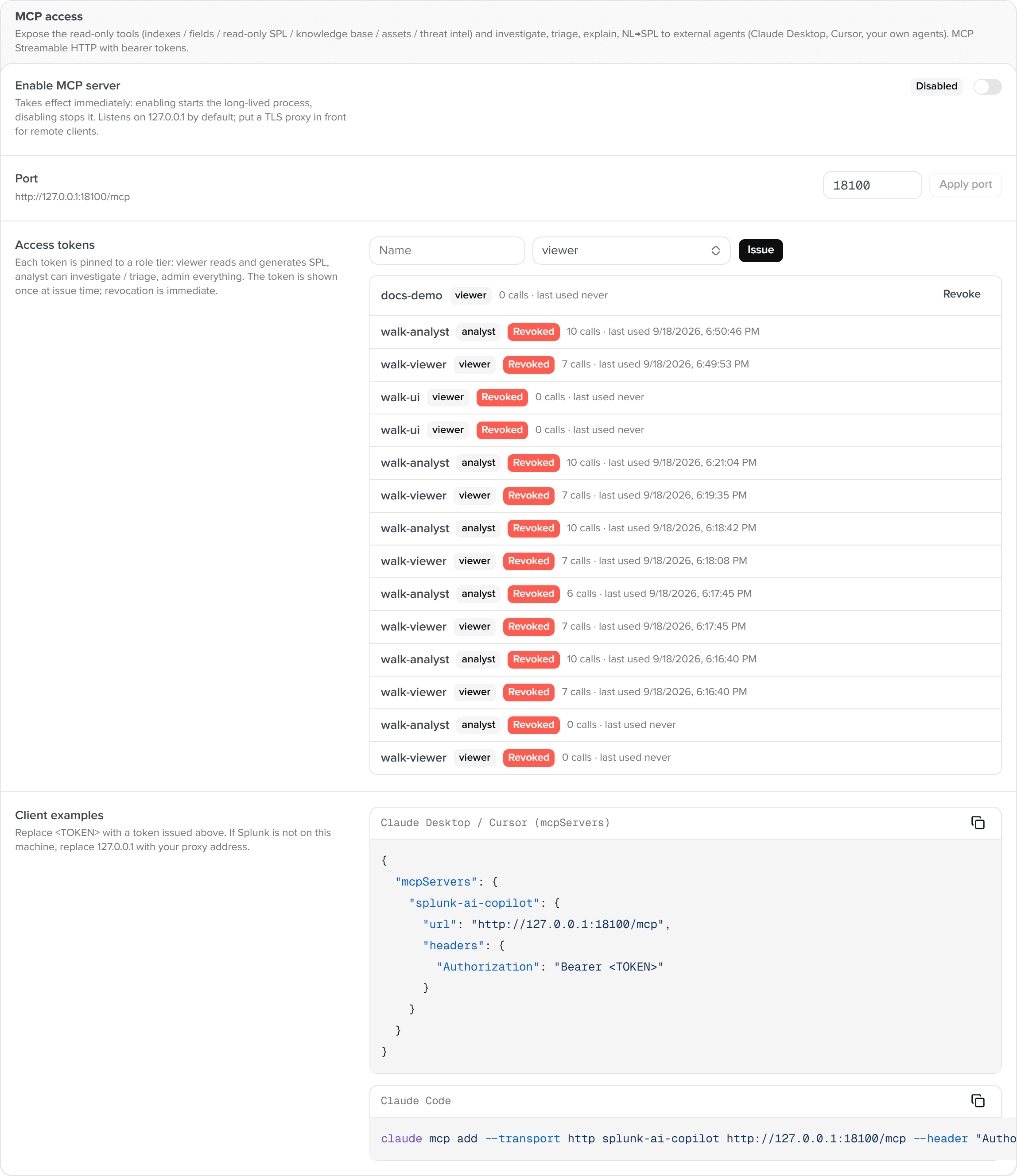
Switch and address
| Item | Default | Notes |
|---|---|---|
| Enabled | off | On starts the process, off stops it |
| Bind | 127.0.0.1 | Loopback / 0.0.0.0 / ::1 only. For other machines put a TLS reverse proxy in front and do access control there; the server itself has no TLS |
| Port | 18100 | |
| Protocol | MCP Streamable HTTP | http://<bind>:<port>/mcp; GET /health is unauthenticated |
Tokens and roles
Every request carries Authorization: Bearer rsk_…. Tokens are issued on this page, the plaintext is shown once, the KV store keeps a sha256 only; revocation is immediate. A token is bound to a role tier and an issuer cannot issue above their own:
| Tier | Tools |
|---|---|
| viewer | list_indexes list_sourcetypes get_fields run_spl search_kb lookup_asset threat_intel generate_spl explain_event |
| analyst | Above + investigate_alert triage_alerts |
| admin | Above (reserved) |
Missing / wrong / revoked token → 401; insufficient tier → the tool returns {"error":"forbidden"} (MCP has no per-tool 403). Rate limiting reuses [limits] rate_per_min / burst, per token.

Tools
| Tool | Notes |
|---|---|
list_indexes() | Indexes with event counts, allow-listed only |
list_sourcetypes(index) | Sourcetypes of an index |
get_fields(index, sourcetype) | Real field names from the last 24h with masked samples |
run_spl(spl) | Read-only SPL, up to 20 rows, masked; delete / collect / outputlookup / sendemail / script / rest … refused |
search_kb(query, k) | Runbook / knowledge-base retrieval (including synced Splunk objects) |
lookup_asset(entity, kind) | Asset / identity context |
threat_intel(indicator, kind) | Threat intel (egresses only with [threat_intel] configured) |
generate_spl(question, index, sourcetype) | Natural language → read-only SPL, same engine as the home page |
explain_event(event, sourcetype) | Single-event explanation |
investigate_alert(alert, context, sourcetype) | Alert investigation (timeline / MITRE / impact / FP verdict) |
triage_alerts(alerts[], max_clusters) | Batch triage clustering and scoring |
Resources: copilot://kb/{id}, copilot://reports/latest; prompt template: investigate.
Security boundary
- Read-only: every Splunk-side call goes through the
bin/tools.pygates: read-only command filter,[limits] agentic_index_whitelist,[masking] mode. - Licence and roles are the UI's: paid tools without a licence return
license_required. - One audit event per call (
via=mcp), filterable in Audit log. - The process searches as
splunk-system-user(absent under a Splunk Free licence, so MCP gets no session there).
Connecting
Claude Desktop / Cursor (mcpServers):
{
  "mcpServers": {
    "splunk-ai-copilot": {
      "url": "http://127.0.0.1:18100/mcp",
      "headers": { "Authorization": "Bearer <TOKEN>" }
    }
  }
}
Claude Code:
claude mcp add --transport http splunk-ai-copilot http://127.0.0.1:18100/mcp \
  --header "Authorization: Bearer <TOKEN>"
Troubleshooting
| Symptom | Where to look |
|---|---|
| Enabled but "not responding" | index=_internal sourcetype=copilot:mcp / copilot_mcp_server in splunkd.log; usually the port is taken or splunk-system-user does not exist |
| Everything 401 | Token revoked / missing Bearer prefix |
Tool returns forbidden | Tier too low; use an analyst token |
license_required | Not activated or licence expired |
refused: index … not in the allowed set | [limits] agentic_index_whitelist omits that index |
License
Which features need a licence, self-serve trial, online and offline activation, what the fingerprint is made of, how the sealed detection engine unlocks, what each status means.
Preferences
The only item in the account menu: language, theme, default index, rows per page, remembered column sets. Passwords are changed in Splunk.