

Field dictionary
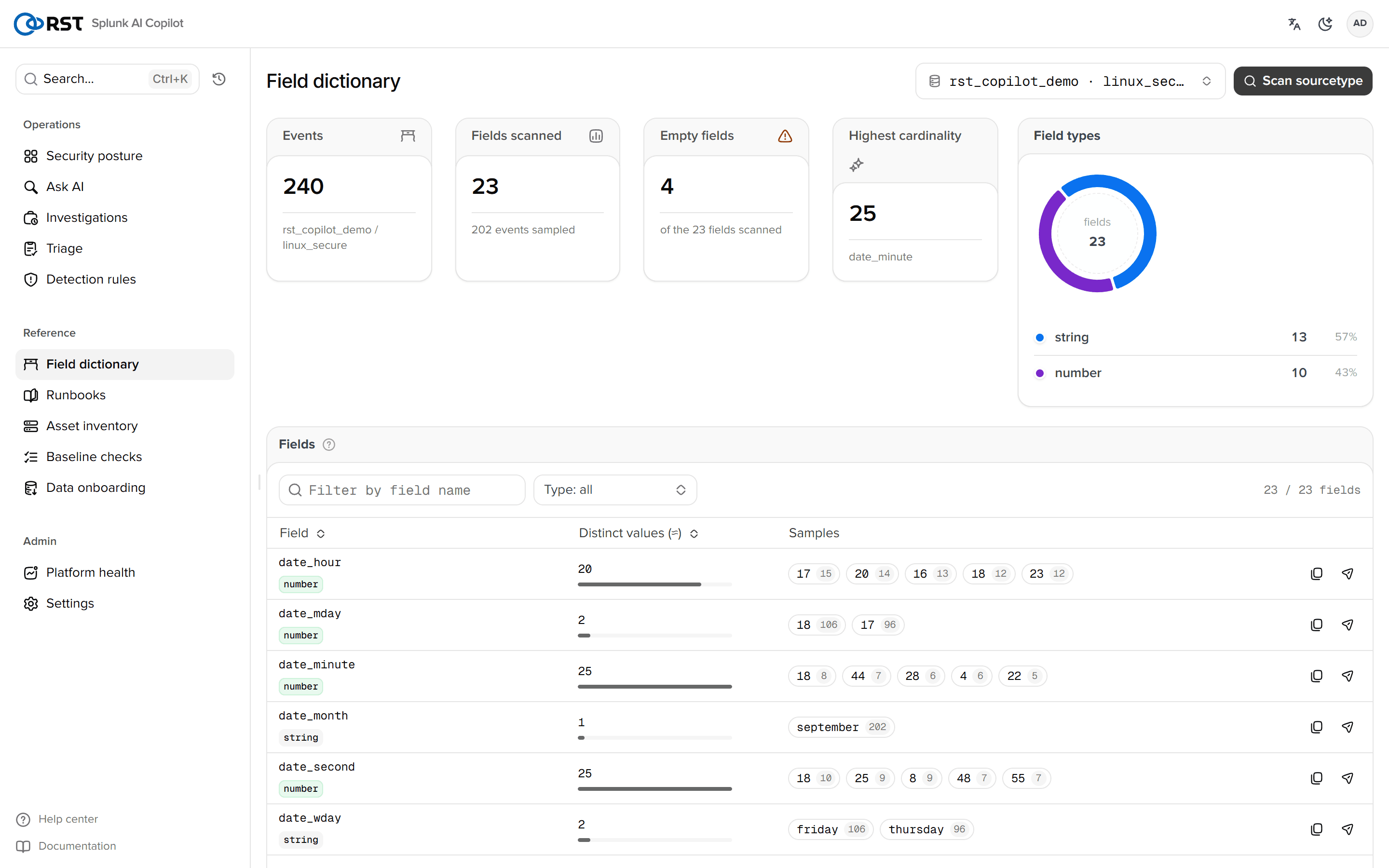
Drill index → sourcetype → field with coverage, type and sample values, read live from Splunk metadata.
The field dictionary answers "what fields does this sourcetype really have, and what do the values look like". The model sees the same data when it writes SPL (the agentic get_fields tool). Available in every edition.
Three levels
| Level | Source |
|---|---|
| index | | eventcount summarize=false index=*, filtered by the allow-list |
| sourcetype | | metadata type=sourcetypes index=<index>, with event count and last seen |
| field | | fieldsummary (last 24 hours, up to 500 sampled events); tstats adds index-time fields |
Picking a sourcetype shows four tiles (events, fields, fields with ≥ 90% coverage, type donut) and the field table.
Field table
| Column | Notes |
|---|---|
| Field | Name, click to copy |
| Type | number / ip / time / string, inferred from fieldsummary numeric counts and samples |
| Coverage | Share of sampled events carrying the field |
| Distinct | Distinct count |
| Samples | Top values with counts, masked per the current mode |
"Empty fields" is almost always 0 on Splunk: fieldsummary lists only fields that occurred. Samples cover the last 24 hours, a different granularity from the Elastic edition's mapping-based view; ask Smart query for anything beyond.
Uses
- Confirm field names before asking (
srcorsrc_ip) so the model does not guess. - After Data onboarding writes a
props.conf, come back to see whether the new fields extract. - "Ask in Smart query" carries the index / sourcetype to the home page.
Detection rules
One sentence of detection intent → a deployable scheduled saved search; deploy, enable, edit in place; an ATT&CK coverage heatmap for gaps. Licensed; the engine ships sealed.
Runbooks
The knowledge base: upload runbooks and SOPs as retrieval context, sync this instance's Splunk objects, the solutions library and correction rules, keyword or semantic retrieval.