

Automember
Attribute regexes that place users / hosts into groups automatically; rules apply to new objects only, existing ones need a rebuild.
An automember rule matches attributes at creation time and adds the object to a group on a hit. "User group rules" match user attributes, "Host group rules" match host attributes.
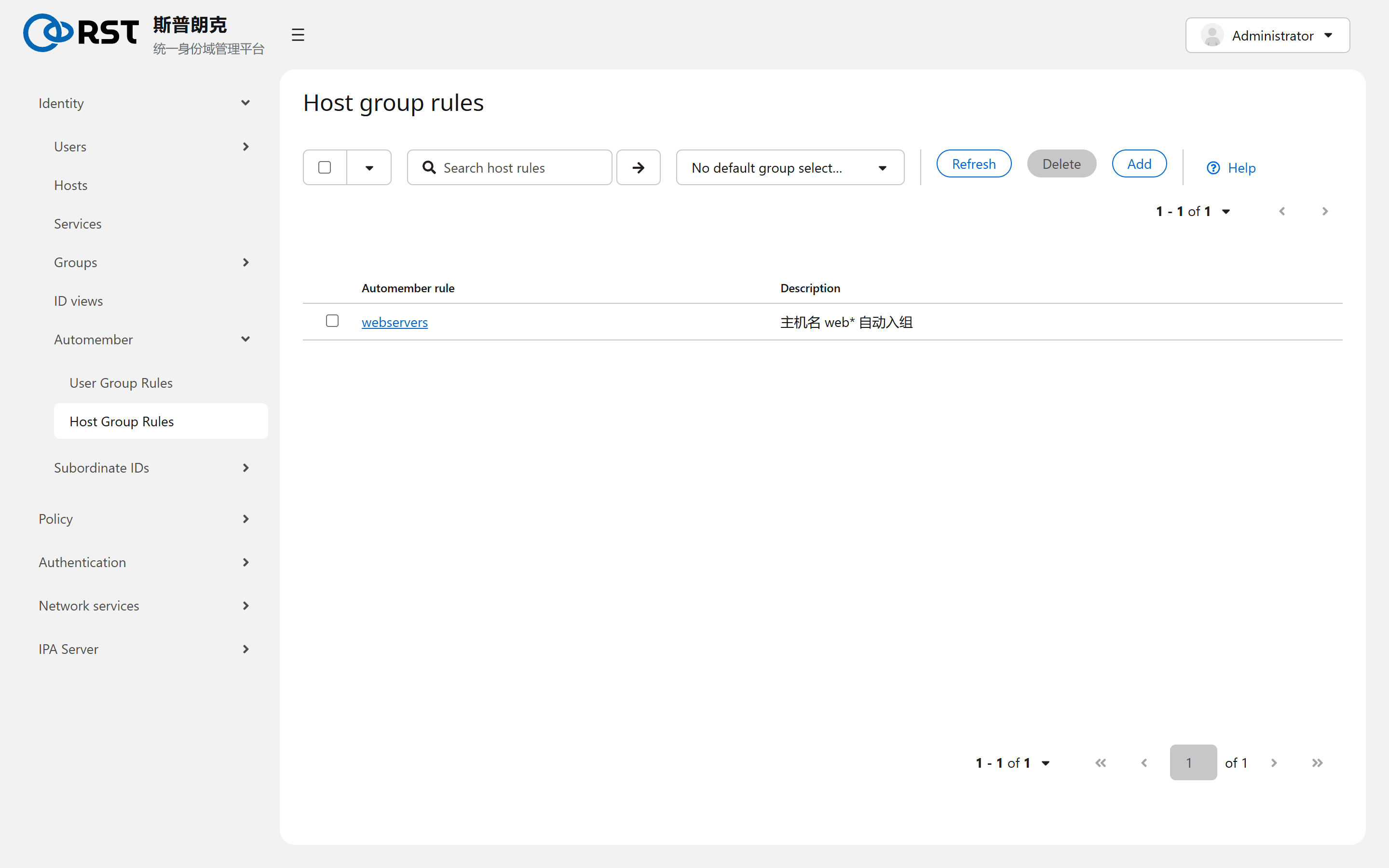
The rule name is the target group: rule webservers puts matching hosts into host group webservers, which must already exist.
Conditions
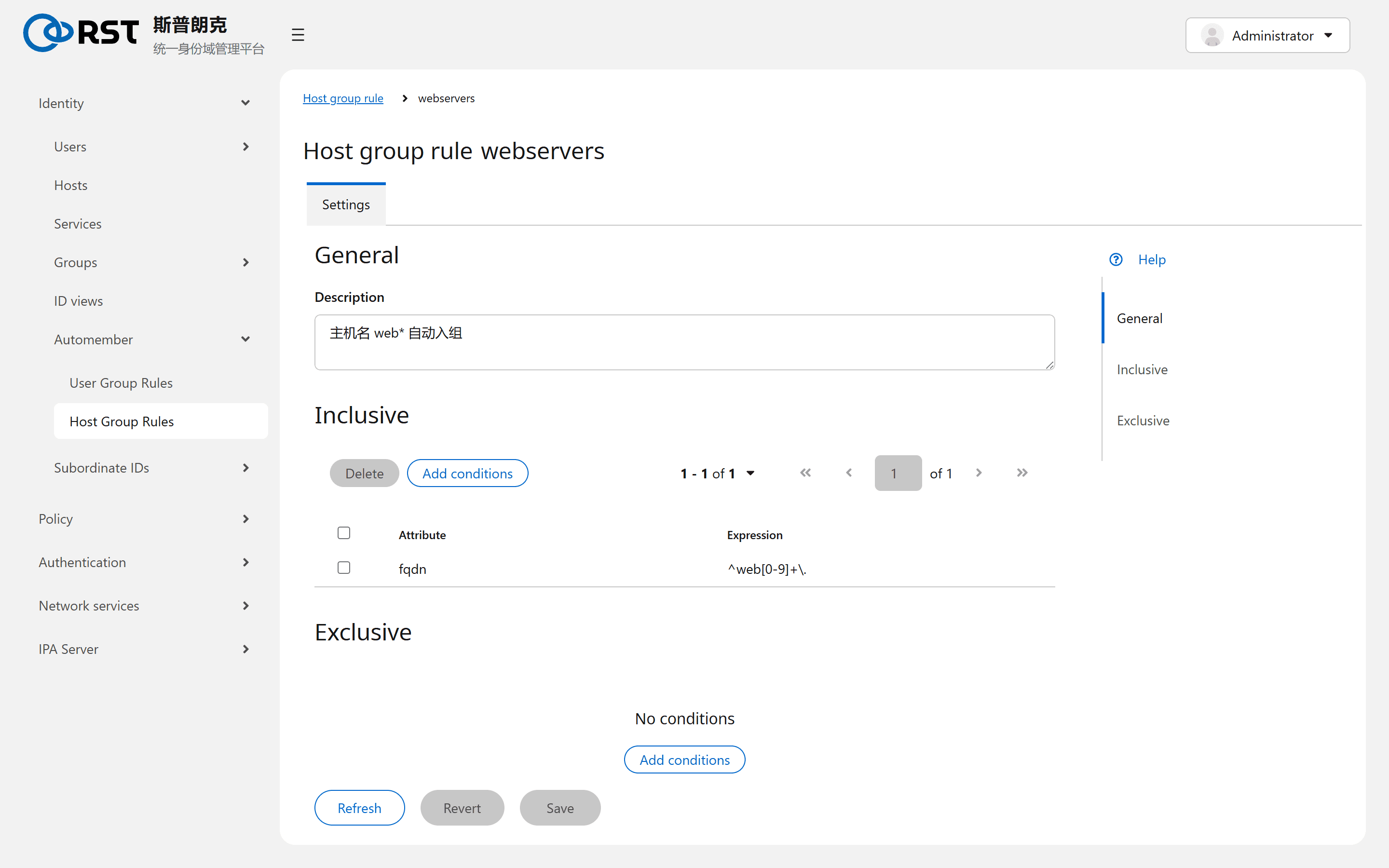
| Part | Meaning |
|---|---|
| Inclusive | attribute + regex; any hit adds the object |
| Exclusive | attribute + regex; any hit excludes it, and wins over Inclusive |
Common attributes: for hosts fqdn, userclass, nshostlocation, ipahostlocation; for users uid, title, departmentnumber, userclass, mail. Regexes are Python syntax, anchor them yourself: ^web[0-9]+\. matches web01. and web02., not webui..
"Default group" (the dropdown on the list page) catches objects no rule matched; usually left unset.
New objects only
Rules are evaluated once, on add. Changing a rule, changing an object's attributes or adding a rule never revisits existing objects. To re-run the rules over them:
ipa automember-rebuild --type=hostgroup
ipa automember-rebuild --type=group --users=zhangwei   # only the given objects
Rebuild is an asynchronous task; ipa automember-find-orphans lists rules whose target group no longer exists.
Boundaries
- A member added by a rule is indistinguishable from one added by hand; it is not removed when the rule stops matching (a rebuild does that).
- A rule cannot refer to another group's membership, only to the object's own attributes.
- AD users never pass through IPA's
user-add, so automember does not apply to them.
ID views
When an ID view is the right tool, which attributes an override can change, how a view is applied to hosts, and why Default Trust View must not be deleted.
Subordinate IDs
Central subuid / subgid allocation for rootless containers; ranges are a fixed 65536, not selectable, never reclaimed; the statistics page shows what is left.